Know personnel costs before the first shift starts
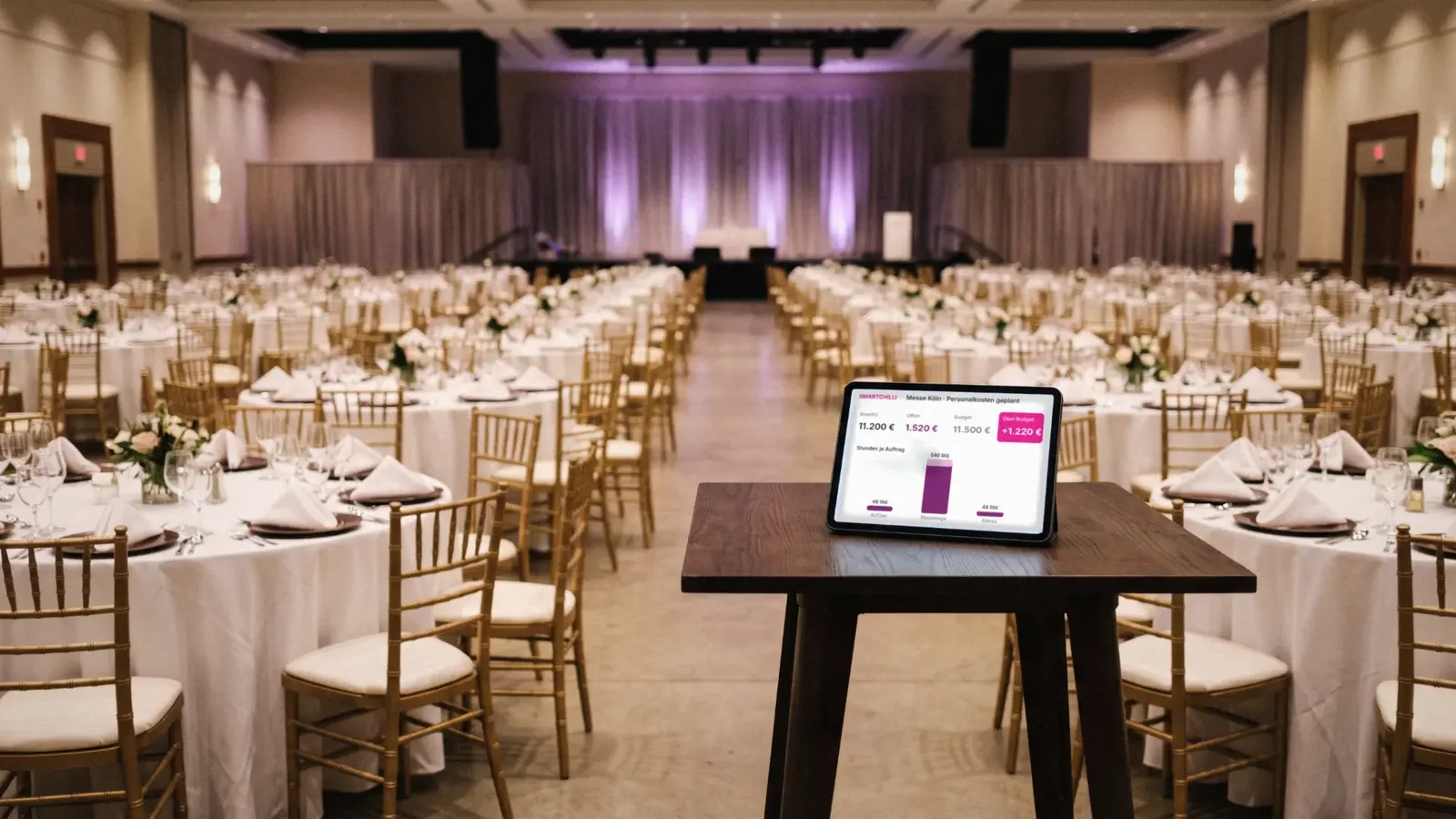

Monday, three weeks before the trade fair. Most of the planning is done, most shifts are filled, and personnel costs are even slightly below budget. A good feeling. By the Thursday before the fair, the last eight positions have been filled too – and the budget has been exceeded.
Nothing has gone wrong. Only what was already there was counted. The unfilled positions had no names yet, so they had no price either.
In brief
- At events and large-scale functions, personnel costs are spread across many orders: setup, event days, teardown and different work stations.
- Adding up only filled shifts systematically underestimates costs – the unfilled positions are missing.
- In 2027, Germany’s statutory minimum wage (Mindestlohn) rises to €14.60. Events sold today already need to be costed on that basis.
- With the December update, SMARTCHILLI shows planned personnel costs per cost object across all orders – with hours and costs for each employee and for unfilled positions.
One event, many orders
For workforce planning, a trade fair is rarely a single order. There is setup, there are the fair days with a stand, lounge and service counter, and there is teardown. Often an evening reception or a VIP area is added too. Each order has its own shifts, work stations and staff.
The client – or your own management – still asks one question: what will staffing this fair cost us? That is exactly what a cost object (Kostenträger) is for. It groups all orders belonging to a project, such as a fair, a season or a major client. Why the number of work stations (Einsatzstellen) matters more than the number of sites in arenas and exhibition halls is something we have described in a separate article.
Unfilled positions are not free
A worked example: catering for a four-day trade fair, spread across three orders.
| Order | Planned hours | Unfilled hours |
|---|---|---|
| Setup (1 day, 6 people × 8 hrs) | 48 | 0 |
| Fair days (3 days, 20 people × 9 hrs) | 540 | 68 |
| Teardown (1 day, 8 people × 6 hrs) | 48 | 8 |
| Total | 636 | 76 |
At an assumed fully loaded rate of €20 per hour, this gives:
| Item | Cost |
|---|---|
| Filled positions (560 hrs) | €11,200 |
| Unfilled positions (76 hrs) | €1,520 |
| Budget | €11,500 |
| Overrun once fully staffed | + €1,220 |
As long as only filled positions count, everything looks fine: €11,200 against a budget of €11,500. Only when unfilled positions are included does it become clear that the plan is €1,220 over budget. And that is at a point when you can still change something – if you can see it.
We have calculated what the opposite costs – one person too many – in our article on overstaffed shifts.
Why we systematically underestimate
Daniel Kahneman and Amos Tversky coined a name for it: the planning fallacy. We estimate costs and effort based on what we can see in front of us. What is still missing is less present in our minds – and therefore gets underestimated.
In workforce planning, this is very tangible: a filled shift has a name, a time and an hourly rate. An unfilled position is just a gap. The solution is not discipline but visibility: unfilled positions must appear in the overview with hours and costs, just like filled ones.
Minimum wage 2027: sell today, pay tomorrow
On 1 January 2027, Germany’s statutory minimum wage rises from €13.90 to €14.60, an increase of around 5 percent. For businesses with many casual staff, this is no footnote. Many events for 2027 are being quoted and contracted now.
In the example above, if the fully loaded rate also rises by around 5 percent to €21, the same fair costs €13,356 rather than €12,720. Anyone pricing 2027 events at 2026 rates today gives away the difference. Read about other changes affecting mini-jobbers in 2027 in our article „Planning mini-jobbers in 2027“.
How SMARTCHILLI helps

In response to numerous customer requests, SMARTCHILLI’s December update shows planned personnel costs (Personalkosten) per cost object:
- All orders at a glance. The analysis brings together all orders belonging to the cost object – setup, event days and teardown.
- Hours and costs per employee. You can see who contributes how many hours to the project and what that costs. This helps, for example, to avoid inadvertently scheduling employees in mini-jobs (Minijobs, marginal employment under German law) right up to their earnings limit.
- Unfilled positions with a price. Positions not yet filled also appear with hours and costs. The gap gets a monetary value.
- Before the first shift. You check the plan while you can still reschedule, renegotiate or adjust shifts.
Together with the new „Clients (Auftraggeber)“ page, where all clients are maintained with their address, contact person and work stations, this creates a complete picture: who the client is, what is planned and what it costs.
Three questions before every event
- Do we know the personnel costs across all orders for this event – not just the largest one?
- Have unfilled positions been included?
- Are we already using the new minimum wage for shifts from January 2027?
Conclusion
Personnel costs arise during planning, not just during payroll. Anyone who sees them fully at that point – including positions that have no one assigned yet – can still act. Anyone who only sees them during payroll can only explain them.
When do you know an event’s personnel costs in your business – beforehand or afterwards?
Try SMARTCHILLI for free
Planning, staffing and personnel costs in one overview. Try SMARTCHILLI for free or let us show you everything in a live demo.
FAQ
Note: the worked example uses assumptions (fully loaded rate of €20 or €21 per hour) for illustration. Minimum wage 2027 according to Germany’s Fifth Minimum Wage Adjustment Ordinance. On the planning fallacy: Kahneman, D. & Tversky, A. (1979): Intuitive prediction: Biases and corrective procedures; Kahneman, D. (2011): Thinking, Fast and Slow.