Social security audit: can you substantiate your mini-jobbers’ pension exemptions?
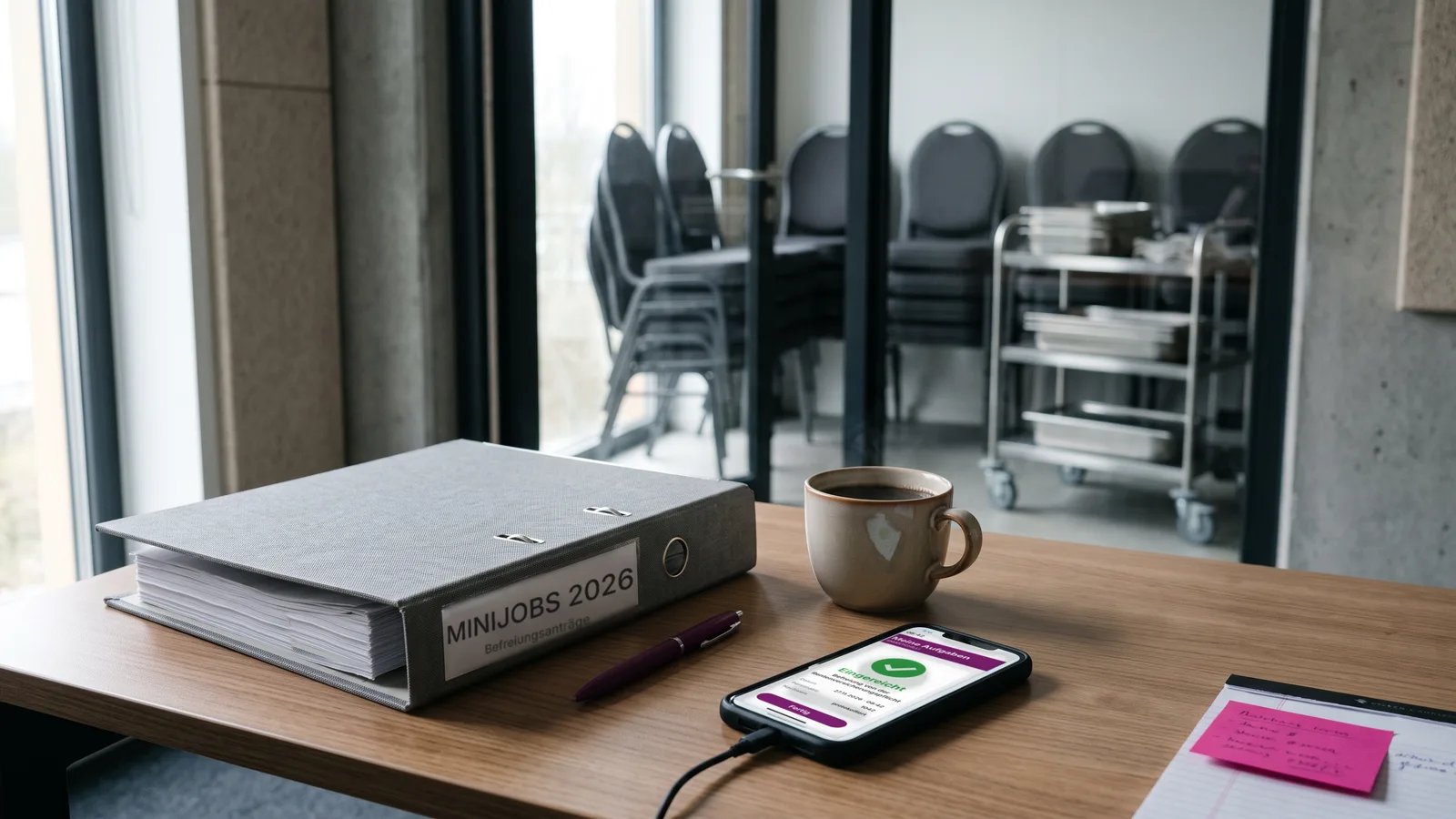

The auditor from German Pension Insurance (Deutsche Rentenversicherung) has the list of your casual workers in front of them. For most, the pension insurance contribution group is 5: exempt. Their request is simple: „Show me the exemption applications.“ The search begins. A folder from 2023, a pile in the scheduling office, a few phone photos in an email inbox. Three applications are missing, and two have no receipt date.
That sounds like a minor issue. But it can be expensive. The exemption application is not a form for the authorities; it is evidence that you, as the employer, must retain.
In brief
- Employees in mini-jobs (Minijobs, marginal employment under German law) apply to you for exemption from compulsory pension insurance – in writing or electronically.
- The application does not go to the Minijob-Zentrale. It belongs in your payroll records with its receipt date.
- If the evidence is missing during a social security audit (Betriebsprüfung), additional contributions may be demanded – and the employer generally bears them.
- Since July 2026, mini-jobbers can revoke their exemption once. This must also be documented.
- With the December update, SMARTCHILLI logs every form submission with the person, personnel number, time and IP address.
The rules in 60 seconds
Mini-jobbers in the commercial sector are generally subject to compulsory pension insurance. They pay their own share of 3.6 percent of their earnings, in addition to the employer’s 15 percent. Anyone who does not want this can apply for an exemption. The process:
- Apply to the employer. The casual worker submits the exemption application to you in writing or electronically. The Minijob-Zentrale provides a template.
- Document receipt. Note the receipt date and add the application to the payroll records. It is not sent to the Minijob-Zentrale.
- Report within six weeks. Notify the exemption through the social insurance declaration, using pension insurance contribution group „5“.
- Objection period. The Minijob-Zentrale may object within one month. If it does not, the exemption applies.
- Effect. If reported on time, the exemption takes effect from the month in which you received the application, but no earlier than the start of employment. Anyone who misses the first month pays contributions until then.
Incidentally, on 1 January 2027 the mini-job earnings limit rises to €633 a month. Our article „Planning mini-jobbers in 2027“ explains what that means for your scheduling.
What the auditor sees – and what they do not
The German Pension Insurance audits employers at least every four years. It may inspect payroll records. From your declarations, the Minijob-Zentrale only knows contribution group 5. The proof that the casual worker actually applied for exemption – and when – exists only with you.
If the application cannot be produced, the exemption cannot be substantiated. Compulsory pension insurance then applies, and the employee’s share is demanded retrospectively. The employer is liable for the total contribution. In practice, you can hardly recover the share from casual workers who no longer work for you.
An example shows what this can amount to:
| Assumption | Value |
|---|---|
| Casual workers without a reliable exemption application | 20 |
| Average monthly earnings | €400 |
| Employee pension insurance share (3.6 %) | €14.40 per month |
| Audit period | 48 months |
| Additional contribution per casual worker | €691.20 |
| Total additional contributions | €13,824 |
€13,824
possible additional contributions in this example
€13,824 – for contributions that nobody actually needed to pay. Just because a sheet of paper is missing. Possible late-payment surcharges are not included.
The typical gaps in the folder
Turnover is high in hospitality, catering and events. Many casual workers start at short notice, and some only work for one season. This is exactly where gaps arise:
- No receipt date. The application is signed, but nobody recorded when it arrived. That makes it impossible to trace when the exemption took effect.
- Wrong storage location. The application sits as a photo in a scheduler’s inbox or a chat – not in the payroll records.
- Applied too late. The application only arrived in the second or third month of employment. The exemption does not then apply retrospectively from the start.
- Underage casual workers. Consent from their legal representatives should always be available.
- Re-employment. Anyone returning after a break has a new employment relationship, often with a new personnel number. Which application belongs to which period?
- New since July 2026: revocation. Mini-jobbers can revoke their exemption once – in writing or electronically to you. It takes effect from the following month, and the contribution group changes from 5 to 1. This application also belongs in the payroll records with its receipt date.
Apply digitally, retain complete evidence

The application may be submitted electronically. This opens the way to completing it where your casual workers already are: in the app. With SMARTCHILLI, it works like this:
- Form as a task (Aufgabe). New casual workers receive the exemption application as a task in the app – for a whole group in one step, if desired.
- Pre-filled. Details SMARTCHILLI already knows are filled in. The casual worker only adds what is missing and submits the form.
- Evidence of every submission. The task history (Aufgabenhistorie) shows who submitted the form, when and from which IP address – with the personnel number valid at that time. The timestamp documents receipt.
- Nothing gets lost. A correctly submitted questionnaire always ends up with its task, even if the task had already been marked as completed.
When the auditor asks for the application, you do not search through folders; you open the casual worker’s file. This works just as well for revoking an exemption or other declarations you need to substantiate during an audit.
Important: SMARTCHILLI does not replace the declaration to the Minijob-Zentrale. That still runs through your payroll. It is best to coordinate the digital process with your tax adviser or payroll team.
Checklist before the next audit
- Is there an exemption application for every casual worker in contribution group 5?
- Does every application have a receipt date – and does it match the start of the exemption?
- Are the applications in the payroll records rather than scattered across inboxes?
- For underage workers, is consent from their legal representatives included?
- Have revocations since July 2026 been documented and reported?
Read more about documenting working hours in our practical guide to time tracking.
Conclusion
For mini-jobbers, exemption from compulsory pension insurance is a decision that takes a few minutes. For employers, it is evidence that must still be retrievable years later. Anyone employing many casual workers should not leave this to the chance of a paper folder.
How quickly could you find all your casual workers’ exemption applications today?
Try SMARTCHILLI for free
Forms, tasks and evidence where your casual workers already are. Try SMARTCHILLI for free or see everything in a live demo.
FAQ
Note: the example calculation uses assumptions for illustration. This article reflects the position as of December 2026 and does not replace legal or tax advice. Sources: Minijob-Zentrale (exemption from compulsory pension insurance; employer audits: what mini-job employers should know; mini-jobs in 2027), marginal employment guidelines, information from Techniker Krankenkasse and AOK on revoking exemptions from July 2026.