What does an overstaffed shift cost?
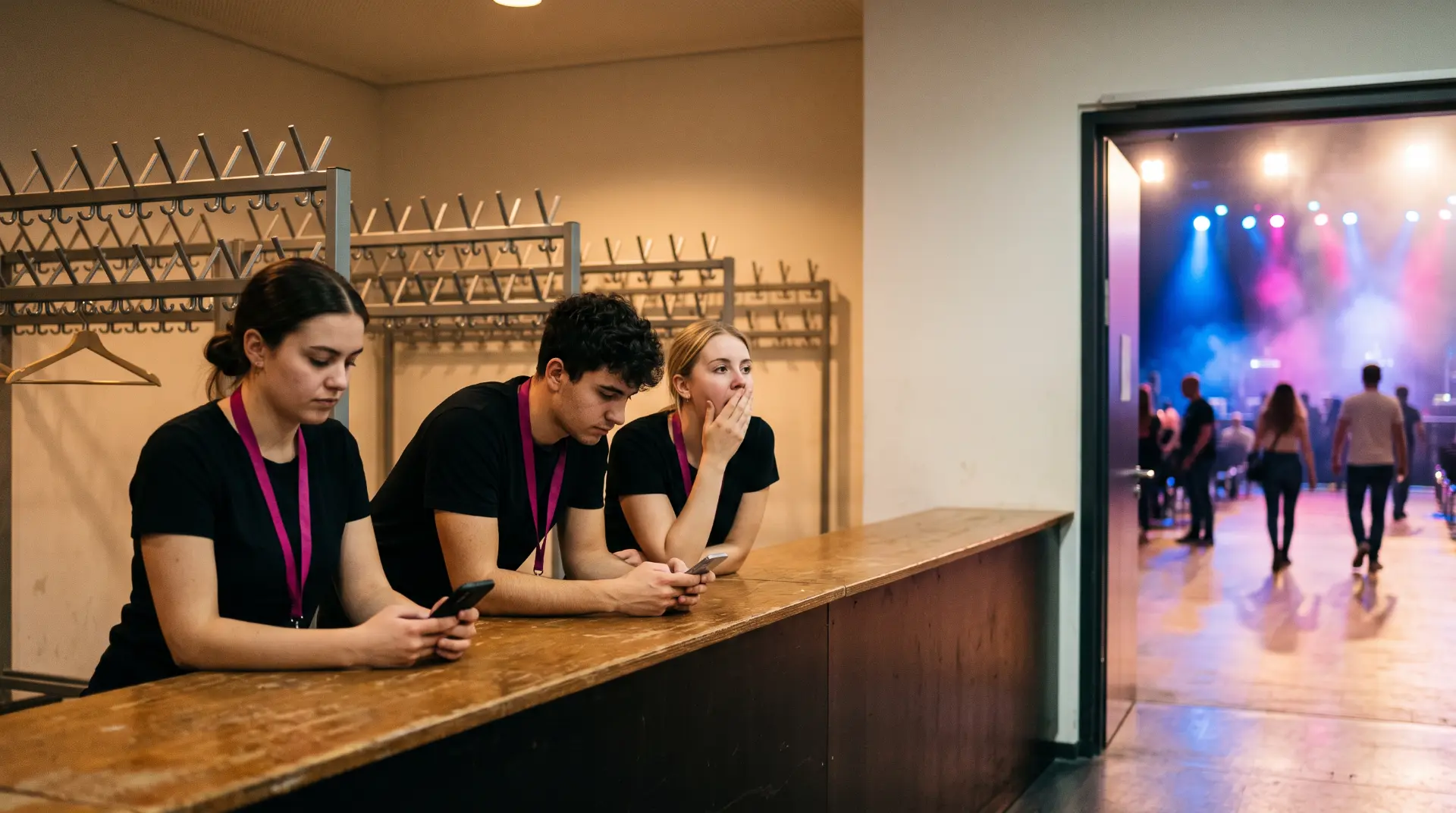

Better two people too many than one too few. In many event and catering businesses this is everyday practice, and it feels sensible. An empty bar on a concert night is visible, loud and embarrassing. Three people looking at their phones at cloakroom 2, or being sent home after an hour, go unnoticed. They still get paid.
In short
- Anyone who turns up and isn't needed costs at least the minimum paid shift length. At 4 hours that is around €78 per person, including employer contributions.
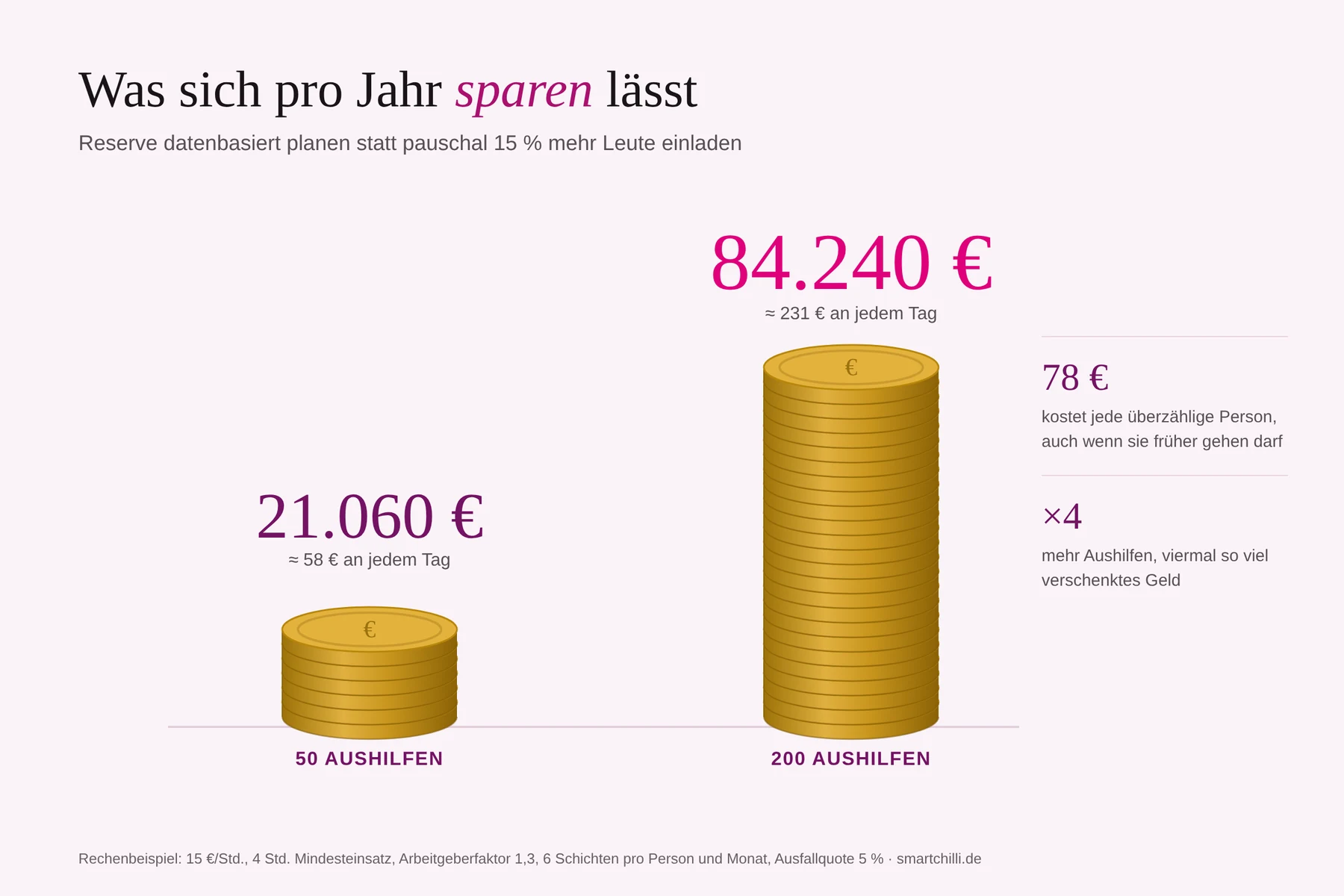
- A business with 50 casual staff can save around €21,000 a year by planning reserve staff with data instead of gut feeling.
- With 200 casual staff it is around €84,000 a year, or a good €230 every single day.
- Overstaffing is usually insurance against uncertainty. If you know your no-show rate, you need far less of it.
€78
per surplus person
€21,060
savings per year with 50 casual staff
€84,240
savings per year with 200 casual staff
The calculation: one person too many
In practice, a surplus worker rarely stays for the whole shift. They are sent home, but the agreed minimum paid shift length is still paid. In many event and catering businesses that is 4 hours. For on-call work, the law requires at least 3 consecutive hours unless otherwise agreed.
From 1 January 2027 the statutory minimum wage in Germany is €14.60 per hour. Event and catering businesses often pay a little more. We therefore calculate with €15 per hour. For commercial mini-jobs the employer pays a flat rate of up to 31.17 % on top, plus accident insurance. For simplicity we use a factor of 1.3.
| Item | Value |
|---|---|
| Hourly wage | €15.00 |
| Minimum paid shift length | 4 hours |
| Wages | €60.00 |
| Employer contributions (factor 1.3) | + €18.00 |
| Cost per surplus person | €78.00 |
€78 is the lower limit. If the person stays for the whole shift because “you might still need someone”, at 6 hours they already cost €117.
€78 doesn't sound like much. It gets interesting when you scale the figure up to a whole business.
Scaled up: 50 and 200 casual staff compared
We compare two typical businesses: an event caterer with 50 casual staff and an arena or trade fair operator with 200 casual staff. On average each person works 6 shifts a month, which fits well with the mini-job earnings limit.
Both businesses plan their reserve staff in two ways:
- By gut feeling: invite a flat 15 % more people than needed.
- Data-based: the actual no-show rate is 5 %. Add a small safety margin, giving about 7.5 % reserve staff in total.
With a 5 % no-show rate, the gut-feeling buffer leaves around 10 % of people standing around for nothing. With data-based reserve staff it is only about 2.5 %.
| 50 casual staff | 200 casual staff | |
|---|---|---|
| Shifts per year | 3,600 | 14,400 |
| Surplus assignments by gut feeling (10 %) | 360 | 1,440 |
| Cost by gut feeling | €28,080 | €112,320 |
| Surplus assignments data-based (2.5 %) | 90 | 360 |
| Cost data-based | €7,020 | €28,080 |
| Savings per year | €21,060 | €84,240 |
| … per month | €1,755 | €7,020 |
| … per day | €58 | €231 |
For context:
- At the caterer with 50 casual staff, a good €1,700 stands around at the cloakroom every month. That is roughly one extra part-time employee who never appears on the roster.
- At the arena operator with 200 casual staff, around €230 goes every day into assignments nobody needed, even on days without an event. Over the year that is more than a full-time position in dispatching costs.
On top of that comes an item that appears on no payslip: coordination. Every surplus worker has to be requested, confirmed, briefed, reminded and finally signed off again. How much office time that takes in your business is shown by our savings calculator.
And the other side: what does one person too few cost?
To be fair, the other side belongs in the calculation too. If a bar is one person short, queues form. Some guests don't even join the queue. A simple model:
An example with assumptions: one person at the bar generates €250 in revenue per hour. If they are missing for three hours and a third of that is lost, that is around €250. That is more than the €78 for a surplus person. Which is exactly why businesses like to top up.
The point is not that reserve staff are wrong. The point is: without data, nobody knows how much reserve is needed. Then “a little buffer” quickly turns into a fixed surcharge.
Why we systematically plan too many
Behavioural economics has a name for it: loss aversion. Daniel Kahneman and Amos Tversky showed that losses weigh psychologically about twice as heavily as gains of the same size. We experience understaffing as a loss: guests are annoyed, the team is stressed, customers complain. The €78 saved, on the other hand, is an abstract gain, and it is spread invisibly across the whole year.
Then there is uncertainty. If you don't know whether 38 or 32 of 40 confirmed people will show up, you plan for the worst case out of caution. That caution costs money every evening.
Reserve staff with data instead of gut feeling
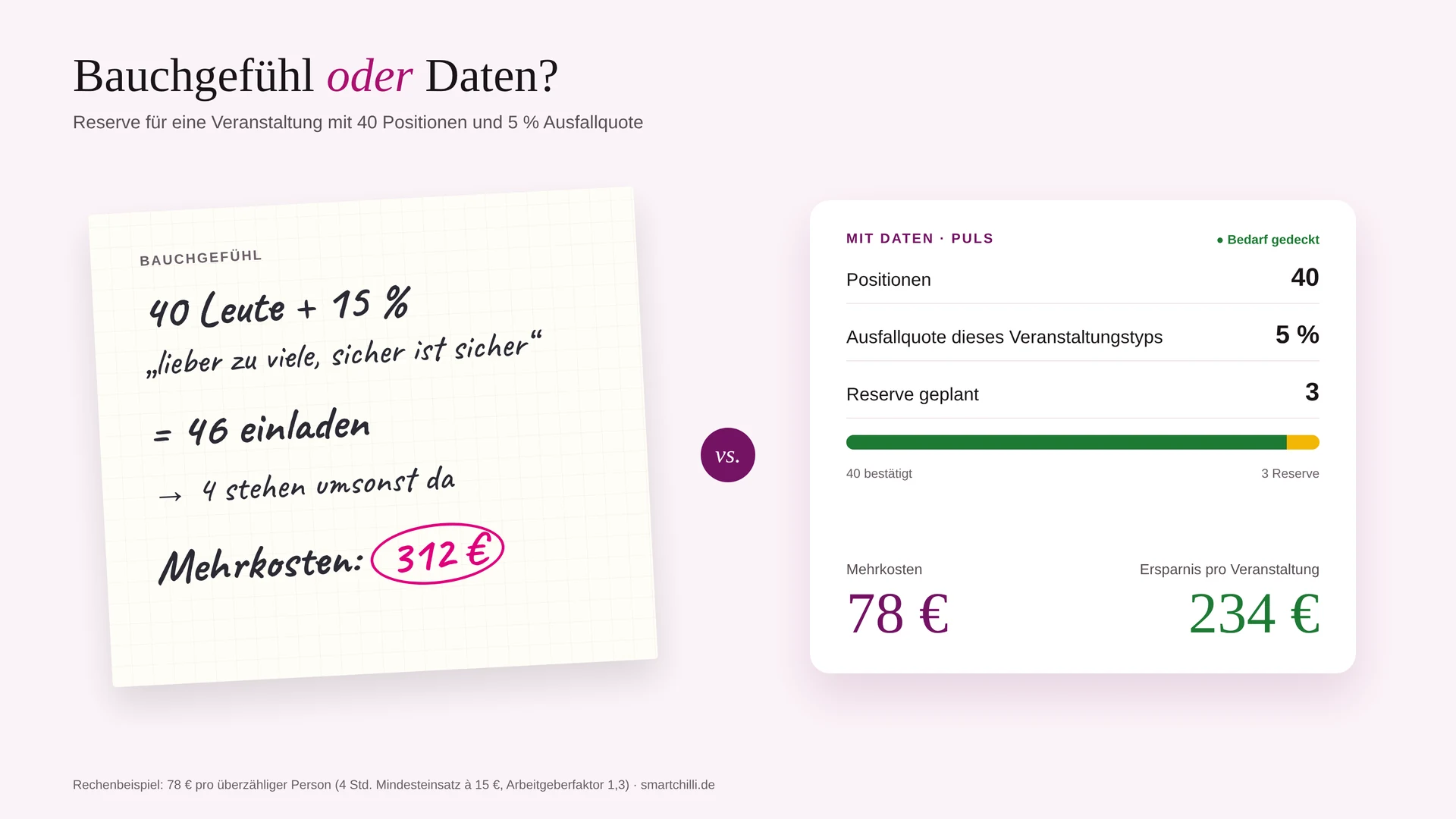
The same principle on a small scale, for a single event with 40 positions and a 5 % no-show rate:
| Approach | Reserve staff | Of whom on site for nothing | Extra cost |
|---|---|---|---|
| Gut feeling: flat +15 % | 6 people | 4 people | €312 |
| Data-based: no-show rate 5 % + 1 person safety margin | 3 people | 1 person | €78 |
Simply knowing the no-show rate cuts the extra cost by €234 per event. It takes three metrics:
- Response rate: how many of those asked have made a decision at all?
- No-show rate: how many confirmations are cancelled at short notice or not honoured, broken down by event type?
- Reliability per person: who confirms and actually comes, and who tends not to?
How to measure such metrics is described in our post The 7 key workforce planning metrics.
How SMARTCHILLI helps
- PULS shows live for each event how many positions are filled, how many of those asked have already decided and how many further confirmations can realistically still be expected. Reserve staff are planned explicitly there rather than silently added on top.
- Voluntary confirmations by swipe ensure that only people who really want to work are scheduled.
- The hours alert shows who is already close to the mini-job limit. That matters so replacement staff don't exceed the limit (mini-jobs 2027).
Conclusion
A surplus person costs €78. With 50 casual staff that adds up to more than €20,000 a year, with 200 casual staff to more than €80,000. The lever is not to plan more tightly but more precisely: if you know your no-show rate, you use reserve staff in a targeted way and save the rest.
How much could your business save? Calculate your savings potential in two minutes, without registration.
FAQ
As of: November 2026. The example values (hourly wage €15, minimum paid shift length 4 hours, 6 shifts per person per month, no-show rate 5 %, revenue per person) are assumptions for illustration. This post does not replace legal advice in individual cases.
Ready to drop the gut feeling?
Try SMARTCHILLI free for one month and experience scheduling without guesswork.
Book a live demo